.png?width=100&height=75&name=Untitled%20design%20(31).png)
I. COMBO SHOP
- What is a combo-shop pharmacy?
- A "combo shop pharmacy" refers to a pharmacy that holds two National Provider Identifiers (NPIs): one for retail services and another for long-term care (LTC) services.
- This setup allows the pharmacy to engage in billing contracts for both retail and LTC services.
- It operates as a comprehensive pharmacy facility that caters to both traditional retail customers and those requiring long-term care services.
- This dual-NPI approach enables the pharmacy to efficiently manage and bill for services associated with both retail and long-term care contracts.
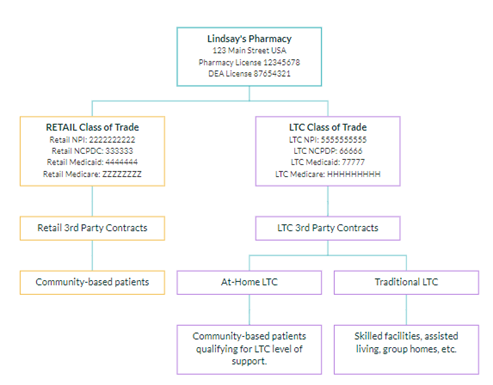 Is a closed-door LTC NPI the same thing as a combo shop?
- No:
- An NPI is a National Provider Identification Number. An LTC NPI can operate under:
- A stand-alone closed-door LTC pharmacy;
- This pharmacy bills ONLY under an LTC NPI
- This pharmacy can be located:
- by itself; or
- In the same building/shopping center as a retail pharmacy under same ownership but not the same formal location
- Example: Retail is in Suite A/Floor 1; LTC is in Suite B/Floor 2
- No:
-
-
- See graph above.
-
II. LTC@Home
- What pharmacies should want LTC@Home – what should they already be doing that is an indicator of LTC@Home population
- Pharmacies that are utilizing compliance packaging, support delivery, have a patient population that is chronically ill, provide additional clinical support services like medication reviews, and diabetic education.
- What are the benefits of a pharmacy ‘doing’ LTC@Home?
- The benefits include better reimbursements and dispensing fees, avoidance or mitigation of DIR fees, a proactive workflow approach, the provision of more comprehensive and improved pharmacy care for patients, and the establishment of better relationships with healthcare providers.
- Should a pharmacy still pursue LTC@Home if not all payers are on board?
- Yes, it's recommended. Apart from potential profitability through operational efficiencies and inventory benefits, having the model ready positions you to seamlessly transition when all payers start reimbursing. It's about preparation and being ready for the opportunities.
- What does a pharmacy get for joining LTC@Home?
- The above support plus:
- Weekly office hours
- Two instances of 'Champion of LTC@Home pharmacy' Continuing Education (CE)
- Exclusive partnerships
- A network of industry experts for questions and support in your LTC@Home journey
- The above support plus:
- Does LTC@H replace my LTC PSAO/GPO like GeriMed or Innovatix/Premier?
- No, it does not serve as a PSAO or GPO. Instead, LTC@Home collaborates closely with PSAOs to enhance contractual compliance, provide education, and promote best practices specifically tailored for LTC@Home.
- Yes, pharmacies have 6 months from being active with CIN to have eCare plan functionality.
Does LTC NPI have to have eCare plan TSP?
III. NPI & TAXONOMY
- Is a closed-door LTC NPI the same thing as a combo shop?
- No:
- An NPI is a National Provider Identification Number. An LTC NPI can operate under:
- A stand-alone closed-door LTC pharmacy;
- A pharmacy in the same building/shopping center as a retail pharmacy under same ownership but not the same formal location
- Retail suite A/Floor 1; LTC suite B/Floor 2; or
- A combo-shop type pharmacy, which is a pharmacy that has both a retail NPI and an LTC NPI that is operating in the same location.
- See graph in Section 1: Combo Shop below Question 1 and above Question 2.
- An NPI is a National Provider Identification Number. An LTC NPI can operate under:
- No:
- What is the difference between NPI and taxonomy?
- NPI (National Provider Identifier) and taxonomy codes are both related to pharmacy, but they serve different purposes.
- National Provider Identifier (NPI):
- Purpose: NPI is a unique 10-digit identification number assigned to all types of healthcare providers and facilities in the United States.
- Usage: It is used to identify providers on standard transactions, such as electronic claims and other HIPAA transactions.
- Uniqueness: Each healthcare provider, including individuals and organizations, is assigned a unique NPI that remains the same throughout their professional life.
- Taxonomy Code:
- Purpose: Taxonomy codes are codes that classify healthcare providers into specific categories or specialties based on their practice or type of services they offer.
- Community/Retail vs LTC Pharmacy
- Usage: These codes help in standardizing the categorization of healthcare providers, making it easier for insurance companies, regulatory bodies, and other entities to understand the type of services provided.
- Specificity: Taxonomy codes are more detailed and specific, providing information about the specialty or area of focus of the healthcare provider.
- Purpose: Taxonomy codes are codes that classify healthcare providers into specific categories or specialties based on their practice or type of services they offer.
- National Provider Identifier (NPI):
- NPI (National Provider Identifier) and taxonomy codes are both related to pharmacy, but they serve different purposes.
- Can 1 NPI have multiple taxonomies on it?
- Yes, 1 NPI can have multiple taxonomies, but only be 1 NPI and 1 Taxonomy type can only be used per contract type in pharmacy.
- Example: Pharmacy A has NPI 1111111111 with 2 taxonomies: RETAIL and LTC
- NPI 111111111 PSAO contract is under the RETAIL taxonomy.
- NPI 111111111 cannot obtain another PSAO contract with the LTC taxonomy.
- Instead, the Pharmacy A must obtain a different NPI, 222222222, with an LTC taxonomy to also participate in an LTC contract.
- Pharmacy A is now a combo shop: NPI 111111111 with Retail Contracts and NPI 222222222 with LTC contracts.
- Instead, the Pharmacy A must obtain a different NPI, 222222222, with an LTC taxonomy to also participate in an LTC contract.
- Example: Pharmacy A has NPI 1111111111 with 2 taxonomies: RETAIL and LTC
- Yes, 1 NPI can have multiple taxonomies, but only be 1 NPI and 1 Taxonomy type can only be used per contract type in pharmacy.
- Is there a requirement for access to 24/7 access for LTC NPIs?
- Yes, CMS requires 24/7 access to participate in CMS contracting for LTC.
- How can I obtain an LTC NPI?
- Click here if you missed it and want to listen to the webinar.
- Click here if you missed it and want to listen to the webinar.
Webinar on How to Obtain an LTC NPI
We have had many requests for assistance to obtain an LTC NPI for community pharmacies that have not applied before. This webinar provided step-by-step instructions with LIVE demonstration.
IV. LTC REQUIREMENTS
- Is there a requirement for access to 24/7 access for LTC NPIs?
- Yes, CMS requires 24/7 access.
- How can a pharmacy meet 24/7 access requirements?
- A pharmacy can choose to:
- Support Internally
- This would require someone at the pharmacy to have a phone line where calls are routed to them 24/7 and they would have access to go to the pharmacy to fulfill stat orders and answer emergency calls.
- Outsource
- There are multiple companies that outsource 24/7 access that meets compliance with CMS for LTC.
- The LTC@HOME Portal has a list of vetted companies that provide 27/7 call and back up pharmacy access pharmacies can research and sign up with individually.
- The LTC@HOME Portal also has a partnership for members to meet CMS compliance support.
- There are multiple companies that outsource 24/7 access that meets compliance with CMS for LTC.
- Support Internally
- A pharmacy can choose to: